

Nov
What is the Mohs Hardness Scale? How many levels does the Mohs scale have?
“Gold is tested by fire, and strength is revealed through adversity.” Metals are proven by flame, people by challenges. As for gemstones, what determines their durability and resistance to scratches isn’t a matter of perception, but a scientific standard: the Mohs Hardness Scale.
This is the “secret” that helps jewelers and jewelry lovers understand why some gemstones remain brilliant through the years, while others show scratches after only a few wears. So what exactly is the Mohs Hardness Scale, and why has it become such a familiar benchmark in the jewelry industry? Let’s explore it together with Meez below.
What is the Mohs Hardness Scale?
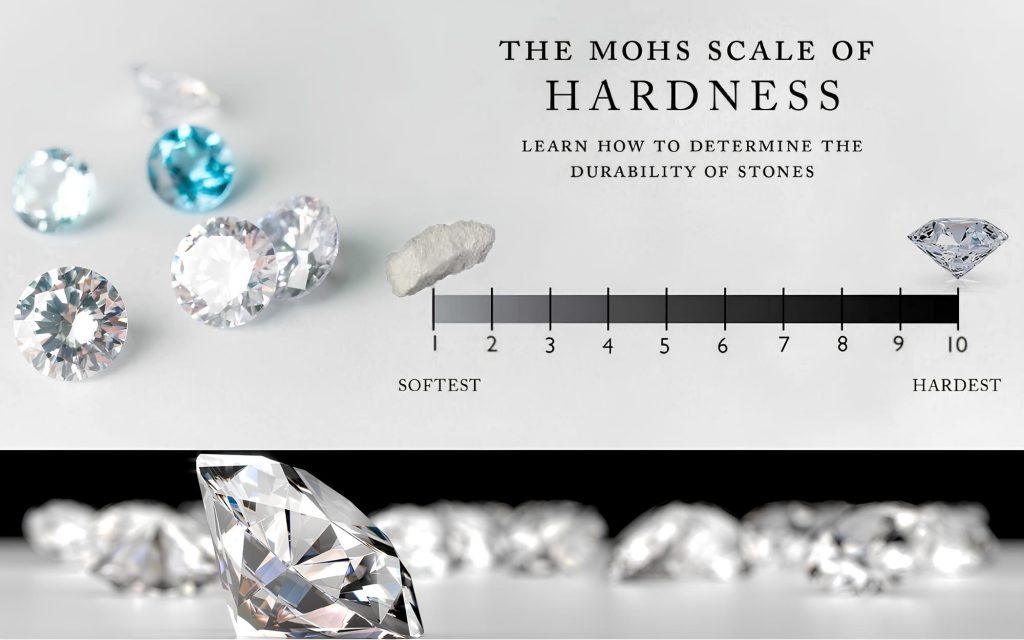
The Mohs Hardness Scale is a system used to assess the relative hardness of minerals, based on their ability to scratch one another. The principle is simple: a mineral with higher hardness can scratch one that is softer.
This system was introduced in 1812 by German mineralogist Friedrich Mohs. With a scale ranging from 1 to 10 — where talc is the softest and diamond is the hardest — the Mohs scale has become an essential standard in the gemstone and jewelry industry.
Thanks to this scale, artisans, experts, and jewelry lovers can determine a gemstone’s durability, scratch resistance, and overall suitability for crafting rings, necklaces, or everyday jewelry. For example, quartz, with a hardness of 7, can scratch glass (around 5.5). Meanwhile, diamond ranks at 10 — the hardest natural material — capable of scratching nearly all other stones.
This is also why diamonds are highly favored in fine jewelry designs at Meez, where long-lasting beauty and durability are always top priorities.
The 10 Levels of the Mohs Hardness Scale
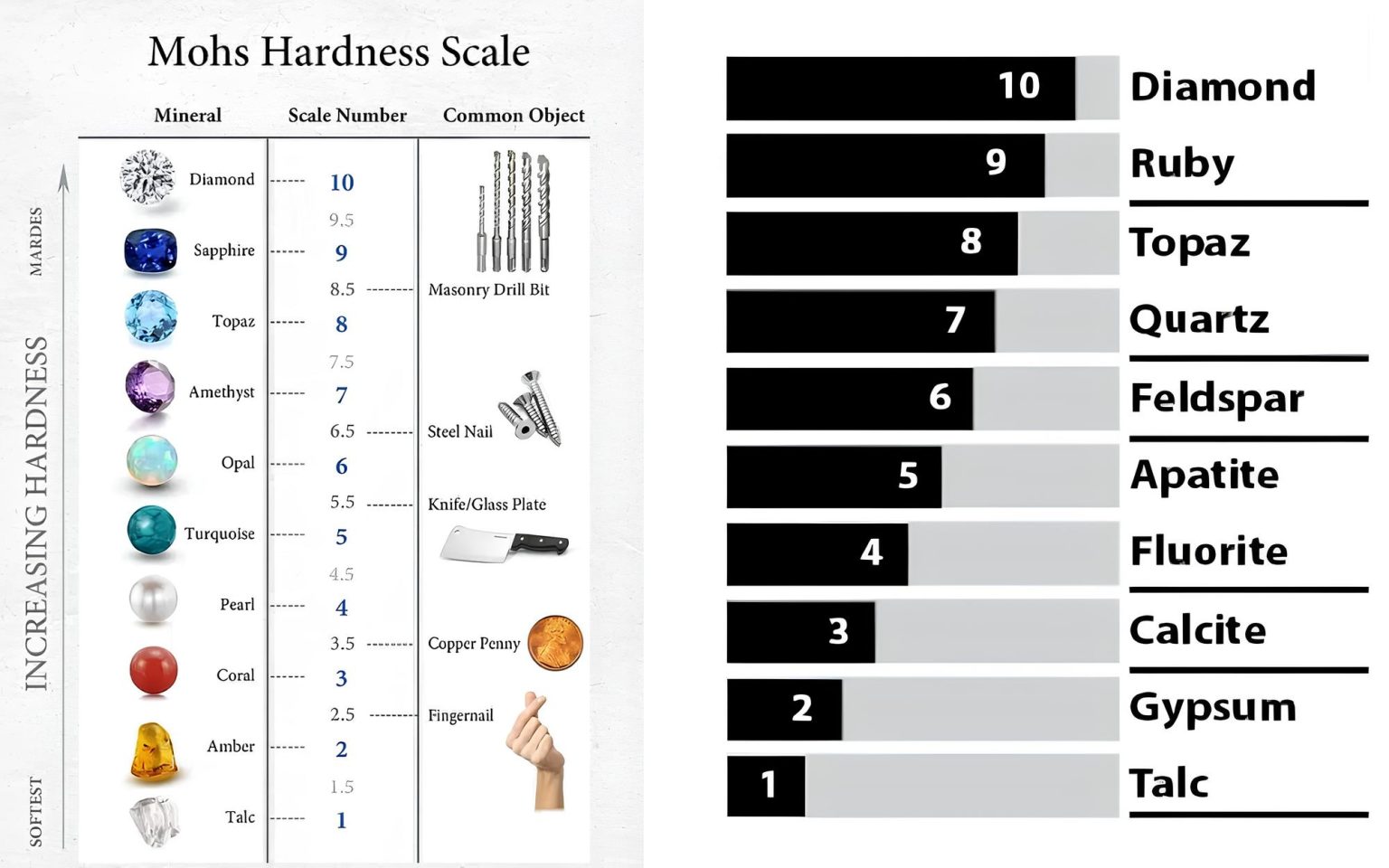
When first introduced, the Mohs scale consisted of 10 levels, each represented by a specific mineral. Hardness is ranked from 1 to 10 — with talc (1) being the softest and diamond (10) the hardest. This framework has long served as a foundation for mineralogists, jewelers, and gemstone craftsmen to evaluate scratch resistance.
Below is the original Mohs scale:
| Rank | Mineral | Physical Characteristics |
| 1 | Talc | So soft it can be scratched with a fingernail |
| 2 | Gypsum | Can still be scratched by a fingernail with firm pressure |
| 3 | Calcite | Can be scratched by a copper coin |
| 4 | Fluorite | Can be scratched by a steel nail or screw |
| 5 | Apatite | Can be scratched by steel tools |
| 6 | Feldspar | Can be scratched by iron or steel |
| 7 | Quartz | Capable of scratching window glass |
| 8 | Topaz | Hard enough to scratch tempered glass |
| 9 | Corundum (ruby/sapphire) | Can scratch topaz but can still be scratched by diamond |
| 10 | Diamond | The hardest natural material, can only be scratched by another diamond |
Although the Mohs scale is a relative system and does not reflect the exact differences in absolute hardness between each level, it remains the most widely used method today. In reality, the gap in hardness between adjacent minerals can be significant — for example, diamond is many times harder than corundum.
Despite certain experimental limitations, particularly because natural minerals are not perfectly uniform in their physical properties, the Mohs scale is still regarded as one of the most important inventions in the field of mineralogy.
Lesser – Known Applications of the Mohs Scale
Assessing Scratch Resistance and Gemstone Durability
In the jewelry industry, the Mohs scale serves as a “hidden tool” for evaluating a gemstone’s hardness. Experts often use a specialized testing kit consisting of 10 pointed tools, each corresponding to one of the 10 minerals on the Mohs scale. They gently apply each point to the surface of the stone; once a visible scratch appears, the hardness of the specimen can be determined.
However, this method is rarely used on high-end jewelry, as it may leave scratches on the piece — something brands like Meez carefully avoid in order to preserve the original beauty of the gemstone.
Applications in Mineral Extraction and New Sample Research
Beyond the jewelry industry, the Mohs scale is also used in mining to identify the hardness of newly discovered minerals. Determining hardness allows specialists to classify minerals accurately, enrich mineralogical data, and select suitable machinery and processing tools.
As a result, both extraction and research processes become more precise and cost-effective.
An Essential Teaching Tool in Mineralogy and Geology
The Mohs Hardness Scale is also widely used in geology lab sessions. Based on the scale, students can analyze mineral samples, identify physical properties, and gain a deeper understanding of material structures as well as the formation processes of different types of rocks.
Mineral hardness also helps scientists estimate the pressure and temperature conditions under which they formed deep within the Earth, opening the door to significant research into geological history.
Although created in the 19th century, the Mohs scale remains a major milestone in mineralogy. Compact, easy to use, cost-effective, and highly practical — these are the reasons it continues to be widely applied today, from laboratories and mining sites to high-end jewelry workshops such as Meez.
How to Determine the Hardness of Gemstones (Minerals)
The hardness of a gemstone is a key factor that determines its scratch resistance and durability in jewelry making. In the jewelry industry, hardness is typically evaluated using the Mohs Hardness Scale — a simple yet highly practical standard that helps identify which stones are durable enough for rings, necklaces, or everyday wear. Below are the most commonly used methods for measuring gemstone hardness in practice.
Determining Hardness Using the Mohs Scale
This is the most trusted method in gemology. The Mohs scale consists of 10 reference minerals, ranging from talc (H=1) to diamond (H=10).
The test is straightforward: use a mineral of known hardness to gently scratch the surface of the sample being examined.
-
If the sample is scratched → it is softer than the testing mineral.
-
If it is not scratched → it is harder.
For example, if a stone is scratched by apatite (H=5) but not by fluorite (H=4), its hardness falls between 4 and 5.
Estimating Hardness with Everyday Objects
When standard mineral samples are unavailable, hardness can be roughly estimated using common items with approximate hardness values:
-
Fingernail: ~2.5
-
Copper coin: ~3.0
-
Steel knife / razor blade: ~5.5
-
Glass shard: ~5.5–6.0
For instance, if a stone is not scratched by a fingernail but is scratched by a coin, its hardness is likely between 2.5 and 3.
Measuring Hardness with Mohs Hardness Picks
In professional gemology, Mohs hardness picks are considered an essential tool. The set includes testing points labeled from 1 to 10, each corresponding to a specific hardness level.
How to use: Gently apply each pick in ascending order. The first pick that leaves a clear scratch indicates the stone’s hardness is just below that level.
Advantages:
-
High accuracy
-
No need for comparison mineral samples
-
Suitable for both rough and cut gemstones
Carefully Examine the Scratch After Testing
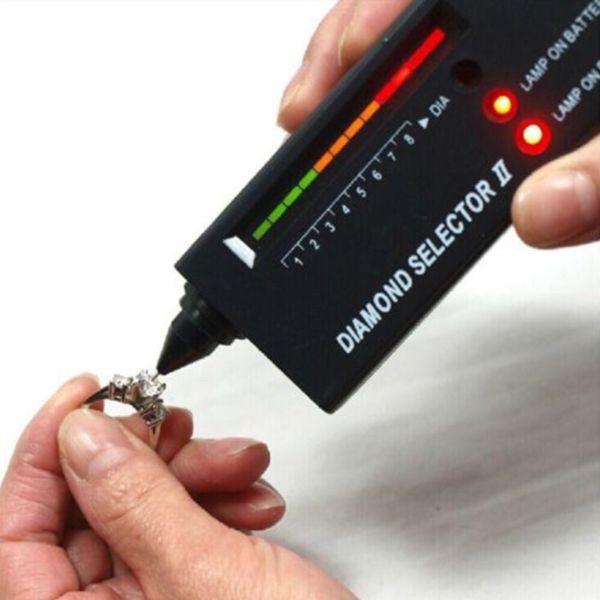
To avoid confusing a real scratch with surface residue, gently wipe the stone and observe it again under proper lighting or with a magnifying glass. A true scratch will remain visible or can be felt with a fingernail, while residue marks will disappear after cleaning.
Combine Hardness with Other Gemstone Properties
Hardness measured on the Mohs scale is only one aspect of mineral identification. For accurate distinction — especially between stones with similar hardness, such as ruby and spinel — experts also evaluate additional characteristics including color, streak, luster, crystal form, and specific gravity.
This comprehensive approach ensures precise identification and a clearer assessment of a gemstone’s actual quality.
See more: All the information you need to know about diamond certification
Important Note
Mohs hardness is not the sole indicator of a gemstone’s durability. For example, diamond ranks 10 on the Mohs scale — making it highly resistant to scratches — yet it can still chip or fracture if subjected to a strong impact at a vulnerable point.
Therefore, when selecting gemstones for jewelry, factors such as toughness, overall durability, and cutting technique must also be carefully considered.
At Meez, these elements are thoroughly evaluated to ensure that every gemstone set into jewelry offers lasting durability, safety, and enduring beauty over time.
- How to fix scratched wedding rings? A simple guide to handling it at home.
- All the information you need to know about diamond certification
- How to Calculate the Correct Ring Size for Both Men and Women
- Which Wedding Ring Material Should You Choose? 10K – 14K – 18K Gold & Platinum
- White Gold Wedding Rings: A Refined Choice for Modern Couples
Bài viết cùng chủ đề:
-
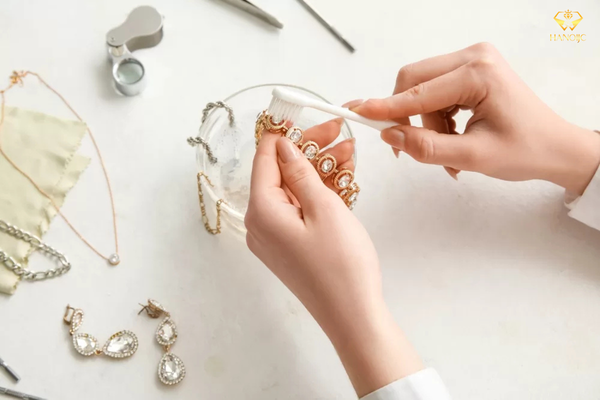
7+ Simple Ways to Make White Gold Shine at Home
-
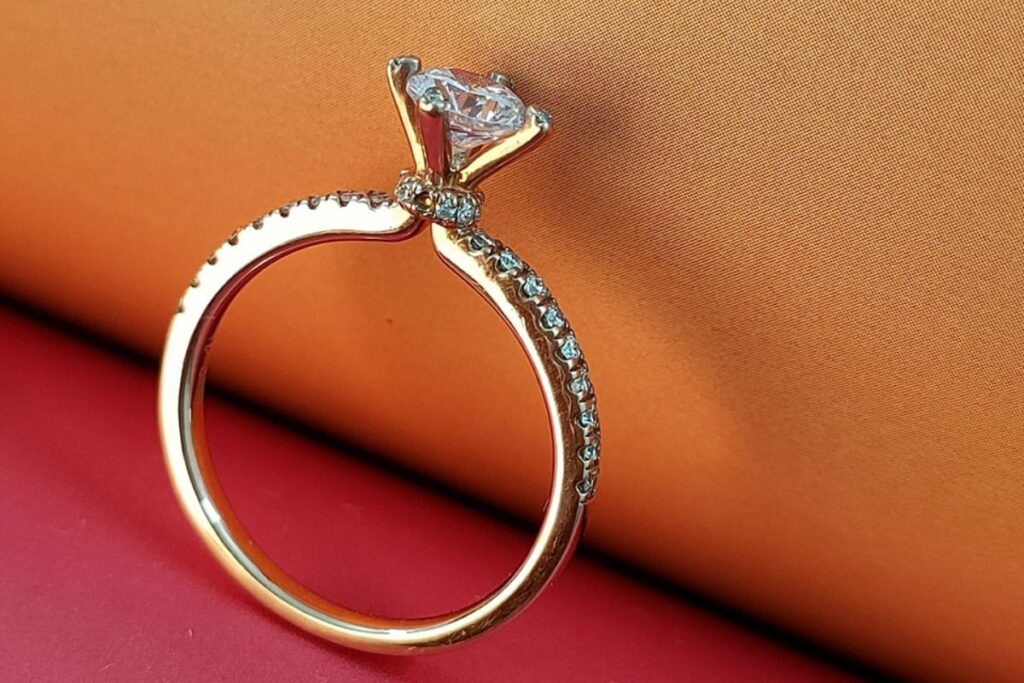
How many millimeters is a 1-carat diamond?
-
Top luxurious gold crown ring designs for women
-
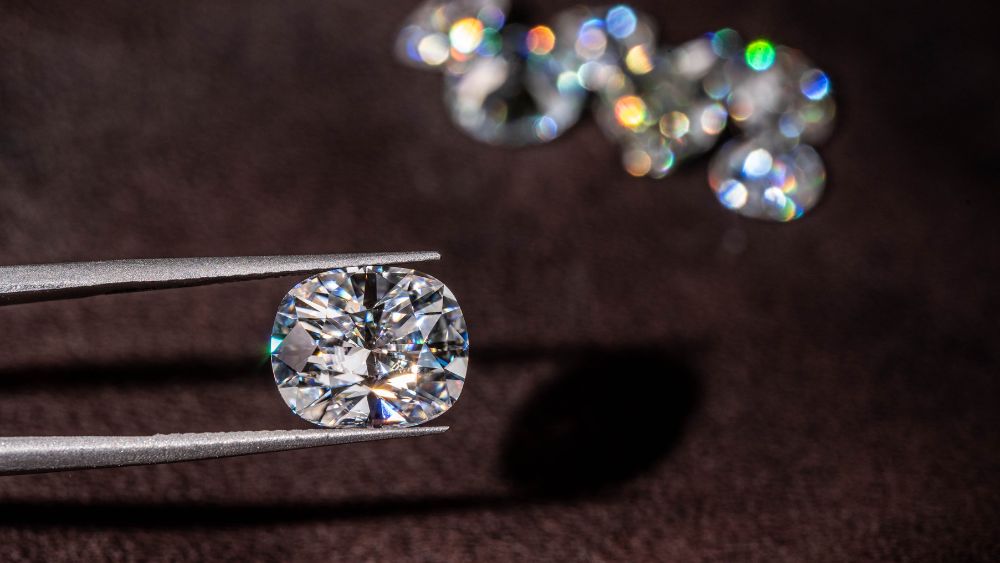
Which diamond color grade is the most beautiful? Helpful Advice Before Buying
-
Explore the 5 Most Loved Necklace Designs of 2026
-

Should dark skin wear gold or silver? Tips for choosing jewelry that enhances your complexion
-
What is CZ stone? Should you buy jewelry set with CZ stones?
-
All the information you need to know about diamond certification
-

Tips for buying an engagement ring online safely
-
How to Calculate the Correct Ring Size for Both Men and Women
-

Tips for Choosing Gold Jewelry Gifts to Match Skin Tone
-
March Birthstones – Aquamarine and Bloodstone
-
Secrets to Designing a Unique and Beautiful Engagement Ring of Your Own

